The Social Psychology of Fear Kurt Riezler Review
Social psychology is the scientific study of how the thoughts, feelings, and behaviors of individuals are influenced past the actual, imagined, and implied presence of others, 'imagined' and 'implied presences' referring to the internalized social norms that humans are influenced by even when they are alone.[ane]
Social psychologists typically explain human behavior as being a result of the relationship between mental state and social situation, studying the weather condition under which thoughts, feelings, and behaviors occur and how these variables influence social interactions.
Social psychology has bridged the gap betwixt psychology and folklore to an extent, simply a divide still exists betwixt the two fields. Nevertheless, sociological approaches to psychology remain an of import counterpart to conventional psychological research.[two] In add-on to the divide betwixt psychology and sociology, there is a departure in emphasis between American and European social psychologists, every bit the former traditionally take focused more on the individual, whereas the latter take generally paid more than attention to group-level phenomena.[iii]
History [edit]
Although problems in social psychology already had been discussed in philosophy for much of human history—such as the writings of the Islamic philosopher Al-Farabi, which dealt with similar issues[four]—the modern, scientific subject began in the United States when the American Sociological Association (ASA) was founded in 1905.[5]
19th century [edit]
In the 19th century, social psychology was an emerging field from the larger field of psychology. At the fourth dimension, many psychologists were concerned with developing concrete explanations for the unlike aspects of human nature. They attempted to observe physical crusade-and-effect relationships that explained social interactions. In order to exercise then, they applied the scientific method to human behavior.[6] The start published written report in the field was Norman Triplett's 1898 experiment on the miracle of social facilitation.[vii] These psychological experiments later went on to class the foundation of much of 20th century social psychological findings.
Early on 20th century [edit]
During World War II, social psychologists were mostly concerned with studies of persuasion and propaganda for the U.S. armed forces (see also psychological warfare). Following the war, researchers became interested in a multifariousness of social problems, including issues of gender and racial prejudice. Most notable and contentious of these were the Milgram experiments. During the years immediately following World War II, there were frequent collaborations between psychologists and sociologists. The two disciplines, nevertheless, take go increasingly specialized and isolated from each other in contempo years, with sociologists generally focusing on macro features whereas psychologists generally focusing on more than micro features.[2]
Late 20th century and modernity [edit]
In the 1960s, there was growing interest in topics such as cognitive dissonance, eyewitness intervention, and aggression. By the 1970s, however, social psychology in America had reached a crisis,[ peacock prose ] as heated debates emerged over bug such as ethical concerns about laboratory experimentation, whether mental attitude could actually predict beliefs, and how much science could be done in a cultural context.[eight] This was also a time when situationism came to claiming the relevance of self and personality in psychology.
Throughout the 1980s and 1990s, social psychology reached a more mature[ peacock prose ] level, peculiarly in regard to theory and methodology. At present, careful ethical standards regulate enquiry, and pluralistic and multicultural perspectives have emerged. Modern researchers are interested in many phenomena, though attribution, social knowledge, and the cocky-concept are perchance the areas of greatest growth in recent years.[10] Social psychologists take also maintained their applied interests with contributions in the social psychology of wellness, education, police, and the workplace.[11]
Intrapersonal phenomena [edit]
Attitudes [edit]
In social psychology, mental attitude is divers as learned, global evaluations (eastward.g. of people or issues) that influence thought and activity.[12] [ page needed ] Attitudes are basic expressions of blessing and disapproval, or as Bem (1970) suggests, likes and dislikes (east.chiliad. enjoying chocolate ice cream, or endorsing the values of a detail party).[thirteen] Because people are influenced by other factors in any given situation, general attitudes are non always good predictors of specific behavior. For example, a person may value the environs but may not recycle a plastic canteen on a particular day.
Research on attitudes has examined the distinction between traditional, self-reported attitudes and implicit, unconscious attitudes. Experiments using the implicit association exam, for instance, accept found that people often demonstrate implicit bias against other races, fifty-fifty when their explicit responses profess equal mindedness.[14] Likewise, one study found that in interracial interactions, explicit attitudes correlate with verbal behavior while implicit attitudes correlate with nonverbal behavior.[15]
Ane hypothesis on how attitudes are formed, first proposed in 1983 by Abraham Tesser, is that strong likes and dislikes are ingrained in our genetic make-upwards. Tesser speculated that individuals are disposed to hold certain strong attitudes equally a result of inborn personality traits and physical, sensory, and cerebral skills. Attitudes are also formed as a upshot of exposure to different experiences, environments, and the learning process. Numerous studies have shown that people tin grade potent attitudes toward neutral objects that are in some way linked to emotionally charged stimuli.[ description needed ] [sixteen] : 185–186
Attitudes are as well involved in several other areas of the discipline, such as conformity, interpersonal attraction, social perception, and prejudice.[17]
Persuasion [edit]
Persuasion is an active method of influencing that attempts to guide people toward the adoption of an attitude, thought, or behavior by rational or emotive ways. Persuasion relies on appeals rather than strong pressure level or compulsion. The procedure of persuasion has been found to exist influenced by numerous variables that more often than not autumn into one of v major categories:[18]
- Communicator: includes credibility, expertise, trustworthiness, and attractiveness.
- Message: includes varying degrees of reason, emotion (e.g. fearfulness), one-sided or two-sided arguments, and other types of informational content.
- Audience: includes a variety of demographics, personality traits, and preferences.
- Channel/medium: includes printed discussion, radio, television, the internet, or face-to-face interactions.
- Context: includes surroundings, group dynamics, and preliminary information to that of Message (category #2).
Dual-process theories of persuasion (such equally the elaboration likelihood model) maintain that persuasion is mediated by two separate routes: central and peripheral. The key route of persuasion is more fact-based and results in longer-lasting change, only requires motivation to procedure. The peripheral route is more superficial and results in shorter-lasting change, but does non require as much motivation to procedure. An example of peripheral persuasion is a political leader using a flag lapel pin, smiling, and wearing a crisp, clean shirt. This does not require motivation to be persuasive, just should not terminal as long equally key persuasion. If that pol were to outline what they believe and their previous voting record, he would exist centrally persuasive, resulting in longer-lasting change at the expense of greater motivation required for processing.[19]
[edit]
Social cognition studies how people perceive, think near, and recall information almost others.[20] Much research rests on the exclamation that people call up nigh other people differently from non-social targets.[21] This exclamation is supported by the social-cognitive deficits exhibited past people with Williams syndrome and autism.[22] Person perception is the written report of how people course impressions of others. The written report of how people form beliefs almost each other while interacting is interpersonal perception.
A major research topic in social cognition is attribution.[23] Attributions are how we explain people's behavior, either our ain behavior or the behavior of others. Ane element of attribution ascribes the cause of behavior to internal and external factors. An internal, or dispositional, attribution reasons that behavior is caused by inner traits such every bit personality, disposition, character, and ability. An external, or situational, attribution reasons that behaviour is caused by situational elements such as the weather.[24] : 111 A second chemical element of attribution ascribes the cause of behavior to stable and unstable factors (i.east. whether the beliefs will be repeated or inverse under like circumstances). Individuals as well attribute causes of beliefs to controllable and uncontrollable factors (i.e. how much control one has over the situation at hand).
Numerous biases in the attribution process have been discovered. For instance, the primal attribution error is the tendency to make dispositional attributions for behavior, overestimating the influence of personality and underestimating the influence of the situational.[25] : 724 The actor-observer bias is a refinement of this; it is the tendency to brand dispositional attributions for other people's beliefs and situational attributions for our own.[24] : 107 The self-serving bias is the trend to attribute dispositional causes for successes, and situational causes for failure, especially when self-esteem is threatened. This leads to bold ane's successes are from innate traits, and one'due south failures are due to situations.[24] : 109 Other means people protect their self-esteem are past believing in a just globe, blaming victims for their suffering, and making defensive attributions that explain our behavior in means that defend us from feelings of vulnerability and mortality.[24] : 111 Researchers have found that mildly depressed individuals oftentimes lack this bias and actually have more realistic perceptions of reality as measured by the opinions of others.[26]
Heuristics [edit]
Heuristics are cognitive shortcuts. Instead of weighing all the show when making a decision, people rely on heuristics to salve time and free energy. The availability heuristic occurs when people estimate the probability of an outcome based on how piece of cake that issue is to imagine. Every bit such, vivid or highly memorable possibilities will be perceived as more than likely than those that are harder to picture or difficult to understand, resulting in a corresponding cognitive bias.[ contradictory ] The representativeness heuristic is a shortcut people apply to categorize something based on how like information technology is to a image they know of.[24] : 63 Numerous other biases have been found by social cognition researchers. The hindsight bias is a false memory of having predicted events, or an exaggeration of actual predictions, later becoming aware of the outcome. The confirmation bias is a type of bias leading to the tendency to search for or interpret information in a way that confirms i's preconceptions.[27]
Schemas [edit]
Another primal concept in social cognition is the assumption that reality is too complex to easily discern. As a issue, we tend to come across the world co-ordinate to simplified schemas or images of reality. Schemas are generalized mental representations that organize knowledge and guide data processing. Schemas often operate automatically and unintentionally and tin lead to biases in perception and memory. Schemas may induce expectations that lead usa to meet something that is not there. One experiment establish that people are more likely to misperceive a weapon in the hands of a black human being than a white homo.[28] This type of schema is a stereotype, a generalized set up of beliefs nigh a particular group of people (when incorrect, an ultimate attribution error). Stereotypes are often related to negative or preferential attitudes (prejudice) and behavior (discrimination). Schemas for behaviors (eastward.thousand., going to a restaurant, doing laundry) are known as scripts.[29]
Self-concept [edit]
Self-concept is the whole sum of behavior that people have about themselves. The cocky-concept is made up of cerebral aspects called cocky-schemas—behavior that people have about themselves and that guide the processing of self-referential information.[xxx] For case, an athlete at a university would take multiple selves that would process different information pertinent to each self: the student would exist oneself, who would process information pertinent to a educatee (taking notes in course, completing a homework assignment, etc.); the athlete would be the self who processes data virtually things related to beingness an athlete (recognizing an incoming pass, aiming a shot, etc.). These selves are role of one's identity and the self-referential data is that which relies on the advisable cocky to process and react to it. If a self is not part of one's identity, then information technology is much more than difficult for one to react. For example, a civilian may non know how to handle a hostile threat as well as a trained Marine would. The Marine contains a self that would enable him/her to process the information about the hostile threat and react accordingly, whereas a civilian may not contain that cocky, lessening the civilian'south power to properly appraise the threat and human action accordingly.
The cocky-concept comprises multiple self-schemas. For example, people whose body image is a meaning cocky-concept aspect are considered schematics with respect to weight. In dissimilarity, people who practice not regard their weight as an important part of their lives are aschematic with respect to that attribute. For individuals, a range of otherwise mundane events—grocery shopping, new clothes, eating out, or going to the beach—can trigger thoughts nearly the self.[xxx]
The cocky is a special object of our attention. Whether one is mentally focused on a memory, a conversation, a foul olfactory property, the song that is stuck in i'southward head, or this sentence, consciousness is like a spotlight. This spotlight can shine on only one object at a time, simply information technology can switch apace from one object to another. In this spotlight the self is forepart and centre: things relating to the self accept the spotlight more often.[31]
The ABCs of self are:[16] : 53
- Impact (i.due east. emotion): How do people evaluate themselves, heighten their self-image, and maintain a secure sense of identity?
- Behavior: How exercise people regulate their own actions and nowadays themselves to others according to interpersonal demands?
- Cognition: How do individuals become themselves, build a self-concept, and uphold a stable sense of identity?
Affective forecasting is the process of predicting how 1 would experience in response to hereafter emotional events. Studies done in 2003 by Timothy Wilson and Daniel Gilbert have shown that people overestimate the forcefulness of their reactions to anticipated positive and negative life events, more than they actually feel when the event does occur.[32]
There are many theories on the perception of our own beliefs. Leon Festinger's 1954 social comparison theory is that people evaluate their own abilities and opinions by comparing themselves to others when they are uncertain of their own ability or opinions.[33] Daryl Bem'south 1972 self-perception theory claims that when internal cues are difficult to interpret, people gain self-insight by observing their ain behavior.[34] There is also the facial feedback hypothesis: changes in facial expression can lead to corresponding changes in emotion.[xvi] : 56
The self-concept is oft divided into a cognitive component, known as the self-schema, and an evaluative component, the self-esteem. The need to maintain a healthy self-esteem is recognized as a central human motivation.[35]
Self-efficacy beliefs are associated with the self-schema. These are expectations that functioning of some task volition be effective and successful. Social psychologists too study such cocky-related processes equally self-control and cocky-presentation.[36]
People develop their self-concepts by various ways, including introspection, feedback from others, cocky-perception, and social comparison. Past comparison themselves to others, people gain data nearly themselves, and they make inferences that are relevant to cocky-esteem. Social comparisons can be either up or down, that is, comparisons to people who are either college or lower in condition or ability.[37] Downwardly comparisons are frequently made in social club to elevate cocky-esteem.[38]
Self-perception is a specialized form of attribution that involves making inferences about oneself later on observing one's ain behavior. Psychologists have establish that besides many extrinsic rewards (east.one thousand. money) tend to reduce intrinsic motivation through the self-perception process, a miracle known equally overjustification. People's attending is directed to the reward, and they lose interest in the job when the reward is no longer offered.[39] This is an of import exception to reinforcement theory.
Interpersonal phenomena [edit]
[edit]
Social influence is an overarching term that denotes the persuasive effects people accept on each other. Information technology is seen as a key value in social psychology. The written report of it overlaps considerably with research into attitudes and persuasion. The three primary areas of social influence include conformity, compliance, and obedience. Social influence is also closely related to the report of group dynamics, equally most effects of influence are strongest when they take place in social groups.
The first major area of social influence is conformity. Conformity is defined as the tendency to act or think similar other members of a group. The identity of members within a grouping (i.e. condition), similarity, expertise, likewise every bit cohesion, prior delivery, and accountability to the grouping help to decide the level of conformity of an individual. Individual variations among group members play a fundamental role in the dynamic of how willing people will be to adjust.[xl] : 27 Conformity is usually viewed as a negative trend in American civilization, but a sure corporeality of conformity is adaptive in some situations, equally is nonconformity in other situations.[40] : 15
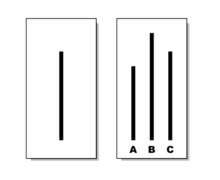
Which line matches the get-go line, A, B, or C? In the Asch conformity experiments, people oft followed the majority judgment, even when the majority was objectively incorrect.
The 2d major surface area of social influence research is compliance, which refers to any change in behavior that is due to a request or suggestion from another person. The foot-in-the-door technique is a compliance method in which the persuader requests a pocket-size favor so follows up with requesting a larger favor, e.g., asking for the fourth dimension and then request for x dollars. A related trick is the allurement and switch.[41]
The tertiary major course of social influence is obedience; this is a alter in behavior that is the upshot of a direct order or command from some other person. Obedience as a grade of compliance was dramatically highlighted by the Milgram study, wherein people were gear up to administer shocks to a person in distress on a researcher's command.[twoscore] : 41
An unusual kind of social influence is the cocky-fulfilling prophecy. This is a prediction that, in being made, causes itself to become true. For example, in the stock marketplace, if it is widely believed that a crash is imminent, investors may lose confidence, sell most of their stock, and thus crusade a crash. Similarly, people may expect hostility in others and induce this hostility by their ain behavior.[24] : 18
Psychologists have spent decades studying the power of social influence, and the way in which it manipulates people's opinions and beliefs. Specifically, social influence refers to the way in which individuals alter their ideas and actions to meet the demands of a social group, received authority, social role, or a minority within a group wielding influence over the majority.[42]
Grouping dynamics [edit]
A group can be defined as two or more individuals who are connected to each other by social relationships.[43] Groups tend to interact, influence each other, and share a common identity. They have a number of emergent qualities that distinguish them from casual, temporary gatherings, which are termed social aggregates:[43]
- Norms: Implicit rules and expectations for grouping members to follow (e.g. saying thank yous, shaking easily).
- Roles: Implicit rules and expectations for specific members within the group (e.g. the oldest sibling, who may accept boosted responsibilities in the family unit).
- Relations: Patterns of liking inside the grouping, and also differences in prestige or condition (e.g. leaders, pop people).
Temporary groups and aggregates share few or none of these features and practice non qualify as true social groups. People waiting in line to go on a autobus, for example, do not found a group.[44]
Groups are important not merely because they offering social support, resources, and a feeling of belonging, simply considering they supplement an individual's cocky-concept. To a big extent, humans ascertain themselves by the grouping memberships which form their social identity. The shared social identity of individuals within a group influences intergroup beliefs, which denotes the way in which groups bear towards and perceive each other. These perceptions and behaviors in plow ascertain the social identity of individuals within the interacting groups. The tendency to define oneself by membership in a group may lead to intergroup discrimination, which involves favorable perceptions and behaviors directed towards the in-group, but negative perceptions and behaviors directed towards the out-grouping.[45] On the other hand, such discrimination and segregation may sometimes exist partly to facilitate a variety that strengthens society.[46] Intergroup discrimination leads to prejudicial stereotyping, while the processes of social facilitation and grouping polarization encourage extreme behaviors towards the out-group.
Groups oft moderate and ameliorate decision making,[47] and are oftentimes relied upon for these benefits, such as in committees and juries. A number of group biases, however, can interfere with effective decision making. For example, group polarization, formerly known every bit the "risky shift", occurs when people polarize their views in a more extreme direction later group word. More problematic is the phenomenon of groupthink, which is a collective thinking defect that is characterized past a premature consensus or an incorrect assumption of consensus, acquired by members of a group failing to promote views that are non consistent with the views of other members. Groupthink occurs in a diversity of situations, including isolation of a group and the presence of a highly directive leader. Janis offered the 1961 Bay of Pigs Invasion as a historical instance of groupthink.[48]
Groups also affect performance and productivity. Social facilitation, for example, is a tendency to work harder and faster in the presence of others. Social facilitation increases the ascendant response 's likelihood, which tends to improve performance on unproblematic tasks and reduce it on complex tasks.[49] In contrast, social loafing is the tendency of individuals to slack off when working in a group. Social loafing is common when the task is considered unimportant and individual contributions are not piece of cake to run into.[50] [ unreliable source? ]
Social psychologists written report grouping-related (collective) phenomena such as the behavior of crowds. An of import concept in this area is deindividuation, a reduced state of self-awareness that can be caused by feelings of anonymity. Deindividuation is associated with uninhibited and sometimes dangerous beliefs. It is common in crowds and mobs, simply information technology can also exist caused by a disguise, a uniform, alcohol, dark environments, or online anonymity.[51] [52]
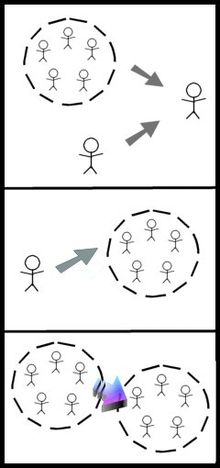
Social psychologists written report interactions within groups, and betwixt both groups and individuals.
Interpersonal attraction [edit]
A major area of study of people's relations to each other is interpersonal attraction, which refers to all forces that lead people to like each other, establish relationships, and (in some cases) fall in love. Several general principles of attraction have been discovered by social psychologists. One of the about important factors in interpersonal attraction is how similar two item people are. The more than similar two people are in general attitudes, backgrounds, environments, worldviews, and other traits, the more probable they volition be attracted to each other.[53] [i]
Concrete attractiveness is an important element of romantic relationships, particularly in the early on stages characterized by high levels of passion. After on, similarity and other compatibility factors become more important, and the type of love people experience shifts from passionate to companionate. In 1986, Robert Sternberg suggested that there are actually iii components of dearest: intimacy, passion, and delivery.[54] When two (or more) people experience all three, they are said to be in a state of consummate love.
Co-ordinate to social commutation theory, relationships are based on rational choice and cost-benefit analysis. A person may leave a relationship if their partner's "costs" begin to outweigh their benefits, peculiarly if there are expert alternatives available. This theory is similar to the minimax principle proposed by mathematicians and economists (despite the fact that human relationships are non nil-sum games). With time, long-term relationships tend to become communal rather than simply based on exchange.[55]
Research [edit]
Methods [edit]
Social psychology is an empirical science that attempts to answer questions about human behavior by testing hypotheses, both in the laboratory and in the field. Careful attention to enquiry design, sampling, and statistical assay is important; results are published in peer-reviewed journals such as the Periodical of Experimental Social Psychology, Personality and Social Psychology Bulletin and the Journal of Personality and Social Psychology. Social psychology studies likewise appear in general science journals such as Psychological Science and Science.
Experimental methods involve the researcher altering a variable in the surroundings and measuring the effect on another variable. An example would be allowing two groups of children to play violent or irenic video games and then observing their subsequent level of aggression during the free-play period. A valid experiment is controlled and uses random assignment.
Correlational methods examine the statistical clan between two naturally occurring variables. For case, one could correlate the number of vehement television shows children watch at habitation with the number of tearing incidents the children participate in at school. Note that this written report would non prove that violent Television receiver causes assailment in children: it is quite possible that aggressive children choose to watch more than trigger-happy TV.
Observational methods are purely descriptive and include naturalistic observation, contrived observation, participant observation, and archival assay. These are less common in social psychology merely are sometimes used when first investigating a phenomenon. An example would be to unobtrusively observe children on a playground (with a videocamera, perhaps) and record the number and types of ambitious actions displayed.
Whenever possible, social psychologists rely on controlled experimentation, which requires the manipulation of one or more independent variables in order to examine the effect on a dependent variable. Experiments are useful in social psychology considering they are high in internal validity, pregnant that they are free from the influence of confounding or inapplicable variables, and and then are more than likely to accurately indicate a causal human relationship. However, the small samples used in controlled experiments are typically low in external validity, or the caste to which the results tin can be generalized to the larger population. There is usually a trade-off between experimental command (internal validity) and being able to generalize to the population (external validity).
Because it is usually impossible to exam anybody, research tends to exist conducted on a sample of persons from the wider population. Social psychologists frequently utilize survey research when they are interested in results that are loftier in external validity. Surveys use various forms of random sampling to obtain a sample of respondents that is representative of a population. This blazon of research is commonly descriptive or correlational because there is no experimental control over variables. Some psychologists have raised concerns for social psychological inquiry relying besides heavily on studies conducted on university undergraduates in bookish settings,[56] [57] or participants from crowdsourcing labor markets such as Amazon Mechanical Turk.[58] [59] In a 1986 study by David O. Sears,[57] over 70% of experiments used N American undergraduates as subjects, a subset of the population that is unrepresentative of the population as a whole.[56]
Regardless of which method has been chosen, the significance of the results is reviewed before accepting them in evaluating an underlying hypothesis. There are two different types of tests that social psychologists use to review their results. Statistics and probability testing define what constitutes a significant finding, which can be every bit low equally v% or less, that is unlikely due to hazard.[60] Replications testing is important in ensuring that the results are valid and non due to take a chance. Faux positive conclusions, often resulting from the pressure to publish or the author'southward own confirmation bias, are a hazard in the field.[61]
Famous experiments [edit]
Asch conformity experiments [edit]
The Asch conformity experiments demonstrated the power of the impulse to conform within minor groups, past the apply of a line-length interpretation task that was designed to be like shooting fish in a barrel to assess but where deliberately wrong answers were given past at to the lowest degree some, oftentimes most, of the other participants.[62] In well over a third of the trials, participants conformed to the majority, even though the majority judgment was conspicuously wrong. Seventy-v percent of the participants conformed at to the lowest degree once during the experiment. Boosted manipulations of the experiment showed that participant conformity decreased when at least one other individual failed to conform just increased when the private began conforming or withdrew from the experiment.[62] Besides, participant conformity increased substantially as the number of "incorrect" individuals increased from i to iii, and remained high equally the wrong majority grew. Participants with iii other, incorrect participants made mistakes 31.8% of the fourth dimension, while those with 1 or two incorrect participants made mistakes only 3.six% and 13.six% of the fourth dimension, respectively.[62]
Festinger (cognitive dissonance) [edit]
In Leon Festinger'southward cerebral dissonance experiment, after beingness divided into two groups participants were asked to perform a boring job and later asked to dishonestly give their opinion of the task, subsequently being rewarded co-ordinate to two different pay scales. At the written report's terminate, some participants were paid $i to say that they enjoyed the task and some other group of participants were paid $20 to tell the same lie. The showtime group ($1) afterward reported liking the job meliorate than the second grouping ($20). Festinger's explanation was that for people in the outset group being paid only $1 is not sufficient incentive for lying and those who were paid $ane experienced dissonance. They could but overcome that racket past justifying their lies by changing their previously unfavorable attitudes about the job. Existence paid $20 provides a reason for doing the boring task resulting in no noise.[63] [64]
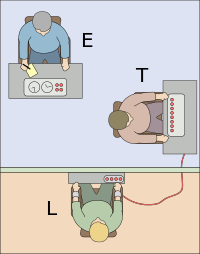
The Milgram experiment: The experimenter (East) persuades the participant (T) to requite what the participant believes are painful electrical shocks to another participant (Fifty), who is actually an actor. Many participants continued to give shocks despite pleas for mercy from the actor.
Milgram experiment [edit]
The Milgram experiment was designed to study how far people would go in obeying an authority figure. Post-obit the events of The Holocaust in Globe State of war Two, the experiment showed that normal American citizens were capable of following orders fifty-fifty when they believed they were causing an innocent person to suffer or even plainly die.[65]
Stanford prison experiment [edit]
Philip Zimbardo's Stanford prison report, a fake exercise involving students playing at being prison guards and inmates, ostensibly showed how far people would go in such office playing. In just a few days, the guards became brutal and cruel, and the prisoners became miserable and compliant. This was initially argued to exist an of import sit-in of the power of the immediate social situation and its capacity to overwhelm normal personality traits.[66] [67] Subsequent research has contested the initial conclusions of the study. For example, it has been pointed out that participant self-selection may take affected the participants' behavior,[68] and that the participants' personalities influenced their reactions in a variety of ways, including how long they chose to remain in the written report. The 2002 BBC prison written report, designed to replicate the weather condition in the Stanford study, produced conclusions that were drastically unlike from the initial findings.[69]
Robber's cave experiment [edit]
Muzafer Sherif'south robbers' cave study divided boys into 2 competing groups to explore how much hostility and aggression would emerge. Sherif's explanation of the results became known every bit realistic group conflict theory, considering the intergroup conflict was induced through competition for resource.[70] Inducing cooperation and superordinate goals later reversed this effect.
Bandura'due south Bobo doll [edit]
Albert Bandura's Bobo doll experiment demonstrated how assailment is learned by fake.[71]
Ethics [edit]
The goal of social psychology is to understand cognition and behavior equally they naturally occur in a social context, merely the very deed of observing people tin influence and modify their behavior. For this reason, many social psychology experiments utilize deception to conceal or misconstrue certain aspects of the study. Charade may include false encompass stories, fake participants (known as confederates or stooges), false feedback given to the participants, and and then on.[ clarification needed ]
The practice of deception has been challenged past psychologists who maintain that deception nether any circumstances is unethical and that other research strategies (eastward.g., role-playing) should exist used instead. Unfortunately, research has shown that office-playing studies practice not produce the same results as deception studies, and this has cast incertitude on their validity.[72] In addition to charade, experimenters accept at times put people into potentially uncomfortable or embarrassing situations (east.thousand., the Milgram experiment and Stanford prison experiment), and this has also been criticized for ethical reasons.
To protect the rights and well-beingness of research participants, and at the same fourth dimension detect meaningful results and insights into human beliefs, virtually all social psychology inquiry must pass an ethical review. At most colleges and universities, this is conducted past an ethics commission or Institutional Review Lath, which examines the proposed research to make sure that no harm is likely to come to the participants, and that the study's benefits outweigh any possible risks or discomforts to people taking part.
Furthermore, a process of informed consent is often used to make sure that volunteers know what will be asked of them in the experiment[ clarification needed ] and understand that they are allowed to quit the experiment at whatsoever time. A debriefing is typically washed at the experiment's conclusion in order to reveal any deceptions used and generally brand certain that the participants are unharmed by the procedures.[ description needed ] Today, nearly enquiry in social psychology involves no more risk of harm than can be expected from routine psychological testing or normal daily activities.[73]
Adolescents [edit]
Social psychology studies what plays key roles in a kid'south development. During this time, teens are faced with many issues and decisions that can impact their social development. They are faced with self-esteem issues, peer pressure, drugs, alcohol, tobacco, sex, and social media.[74]
Psychologists today are not fully aware of the upshot of social media. Social media is worldwide, so one can be influenced by something they will never encounter in real life. In 2019, social media became the unmarried most important activity in adolescents' and even some older adults' lives.[75]
Replication crisis [edit]
Many social psychological research findings have proven difficult to replicate, leading some to debate that social psychology is undergoing a replication crisis.[76] Replication failures are not unique to social psychology and are constitute in all fields of science.[ citation needed ] Some factors take been identified in social psychological research that has led the field to undergo its electric current crisis.
Firstly, questionable enquiry practices accept been identified every bit common. Such practices, while not necessarily intentionally fraudulent, involve converting undesired statistical outcomes into desired outcomes via the manipulation of statistical analyses, sample sizes, or information direction systems, typically to convert non-significant findings into significant ones.[61] Some studies have suggested that at least mild versions of these practices are prevalent.[77] One of the criticisms of Daryl Bem in the feeling the future controversy is that the testify for precognition in the study could be attributed to questionable practices.
Secondly, some social psychologists take published fraudulent research that has entered into mainstream academia, virtually notably the admitted information fabrication past Diederik Stapel[78] also as allegations against others. Fraudulent research is not the main correspondent to the replication crisis.[ citation needed ]
Several effects in social psychology have been establish to be difficult to replicate even earlier the current replication crisis. For instance, the scientific periodical Judgment and Conclusion Making has published several studies over the years that fail to provide support for the unconscious thought theory. Replications appear particularly difficult when inquiry trials are pre-registered and conducted by enquiry groups non highly invested in the theory under questioning.
These three elements together have resulted in renewed attention to replication supported by Daniel Kahneman. Scrutiny of many effects have shown that several cadre behavior are hard to replicate. A 2014 special edition of Social Psychology focused on replication studies, and a number of previously held beliefs were constitute to be difficult to replicate.[79] Likewise, a 2012 special edition of Perspectives on Psychological Science focused on bug ranging from publication bias to null-aversion that contribute to the replication crisis in psychology.[80]
It is important to note that this replication crisis does non hateful that social psychology is unscientific.[81] Rather, this reexamination is a healthy[ peacock prose ] if sometimes begrudging[ peacock prose ] role of the scientific process in which onetime ideas or those that cannot withstand careful scrutiny are pruned.[82] The consequence is that some areas of social psychology once considered solid, such as social priming, have come nether increased scrutiny due to failure to replicate findings.[83]
Academic journals [edit]
- Asian Periodical of Social Psychology
- Bones and Applied Social Psychology
- British Journal of Social Psychology
- European Journal of Social Psychology
- Journal of Applied Social Psychology
- Journal of Experimental Social Psychology
- Periodical of Personality and Social Psychology
- Journal of Social Psychology
- Personality and Social Psychology Message
- Personality and Social Psychology Review
- Social Psychology
See also [edit]
- Association of Psychological and Social Studies
- Oversupply psychology
- Intergroup relations
- European Association of Social Psychology
- Fuzzy-trace theory
- Listing of biases in judgment and decision making
- List of social psychologists
- Sociological arroyo to social psychology
- Society for Personality and Social Psychology
- Order of Experimental Social Psychology
- Socionics
Notes [edit]
- ^ "Thus Interpersonal attraction and attitude similarity have a straight correlation. More so than those with unlike attitudes and views, who tend to not be as successful in the allure department." (Byrne 1961).
References [edit]
- ^ Allport, Thou. W (1985). "The Historical Background of Social Psychology". In Thou. Lindzey and E. Aronson (ed.). The Handbook of Social Psychology. New York: McGraw Hill. p. v.
- ^ a b Sewell, W. H (1989). "Some reflections on the gold age of interdisciplinary social psychology". Annual Review of Sociology. 15: 1–17. doi:10.1146/annurev.then.15.080189.000245. S2CID 143901573.
- ^ Moscovici, S; Markova, I (2006). The Making of Modern Social Psychology. Cambridge, UK: Polity Printing.
- ^ Amber Haque (2004). "Psychology from Islamic Perspective: Contributions of Early on Muslim Scholars and Challenges to Contemporary Muslim Psychologists". Periodical of Faith and Health. 43 (4): 357–377. doi:10.1007/s10943-004-4302-z. JSTOR 27512819. S2CID 38740431.
- ^ Cartwright, Dorwin (March 1979). "Gimmicky Social Psychology in Historical Perspective". Social Psychology Quarterly. 42 (1): 82–93. doi:x.2307/3033880. ISSN 0190-2725. JSTOR 3033880.
- ^ Gergen, K. J. (1973). "Social Psychology every bit History". Periodical of Personality and Social Psychology. 26 (2): 309–320. doi:ten.1037/h0034436.
- ^ Triplett, Norman (1898). "The dynamogenic factors in pacemaking and competition". American Journal of Psychology. 9 (4): 507–533. doi:x.2307/1412188. JSTOR 1412188. S2CID 54217799.
- ^ Gergen, Kenneth J (1973). "Social psychology as history". Periodical of Personality and Social Psychology. 26 (ii): 309–320. doi:10.1037/h0034436.
- ^ Gecas, Viktor (1982). "The Self-Concept". Annual Review of Sociology. viii: 1–33. doi:x.1146/annurev.and then.08.080182.000245. ISSN 0360-0572. JSTOR 2945986.
- ^ Kassin, Saul, Steven Fein, and Hazel R. Markus, (2017). Social Psychology (10th ed.). Belmont, CA: Cengage Learning. ISBN 978-i-305-58022-0. Lay summary via NELSONBrain.
- ^ Sison, Erick Louie A. (2008). The Dynamics of Persuasion. New York: Lawrence Erlbaum.
- ^ Bem, D. (1970). Beliefs, Attitudes, and Human Affairs . Belmont, CA: Brooks/Cole.
- ^ McConnell, Allen (September 2001). "Relations among the Implicit Association Test, Discriminatory Behavior, and Explicit Measures of Racial Attitudes". Journal of Experimental Social Psychology. 37 (5): 435–442. doi:ten.1006/jesp.2000.1470. S2CID 31010334.
- ^ Heider, J. D; Skowronski, J. J (2007). "Improving the Predictive Validity of the Implicit Clan Exam". Due north American Periodical of Psychology. 9: 53–76.
- ^ a b c Kassin, Saul, Steven Fein, and Hazel R. Markus, (2008). Kassin, Saul One thousand.; Fein, Steven; Markus, Hazel Rose (2008), Social Psychology , ISBN9780618868469 (7th ed.). Belmont, CA: Wadsworth Cengage Learning. ISBN 9780618868469. LCCN 2007-926779.
- ^ "Social Psychology". Psynso . Retrieved 21 November 2021.
- ^ Myers, David (2010). Social Psychology (10th ed.). New York: McGraw-Hill. pp. 234–253. ISBN978-0-07-337066-eight.
- ^ Austen, Jane (1919). Northanger Abbey & Persuasion. J.One thousand. Dent. ISBN0-665-83283-4. OCLC 1111908588.
- ^ DeLamater, John D.; et al. (8 July 2014). Social Psychology. ISBN978-0-8133-4951-0. OCLC 883566075.
- ^ Moskowitz, Gordon B (2005). Social Cognition: Understanding Cocky and Others. Texts in Social Psychology. Guilford. ISBN978-1-59385-085-two.
- ^ Dobbs, Davis (8 July 2007). "The Gregarious Brain". The New York Times Magazine.
- ^ Reisenzein, Rainer; Rudolph, Udo (2008). "50 Years of Attribution Research". Social Psychology. 39 (iii): 123–124. doi:ten.1027/1864-9335.39.3.123. ISSN 1864-9335.
- ^ a b c d eastward f Aronson, Elliot; Wilson, Timothy D.; Akert, Robin 1000. (2010). Social Psychology (7 ed.). Prentice Hall.
- ^ Myers, David M. (2007). Psychology (eight ed.). New York: Worth Publishers – via Internet Archive.
- ^ Andrews, P. West. (2001). "The psychology of social chess and the evolution of attribution mechanisms: Explaining the fundamental attribution mistake" (PDF). Evolution and Human Behavior. 22 (1): 11–29. doi:x.1016/S1090-5138(00)00059-3. PMID 11182572.
- ^ "Availability Bias, Source Bias, and Publication Bias in Meta-Analysis", Methods of Meta-Analysis: Correcting Error and Bias in Inquiry Findings, SAGE Publications, Ltd, pp. 513–551, 2015, doi:ten.4135/9781483398105.n13, ISBN978-1-4522-8689-i
- ^ Correll, Joshua; Park, Bernadette; Judd, Charles M; Wittenbrink, Bernd (2002). "The law officer's dilemma: Using ethnicity to disambiguate potentially threatening individuals". Journal of Personality and Social Psychology. 83 (half dozen): 1, 314–1, 329. CiteSeerX10.1.1.466.7243. doi:x.1037/0022-3514.83.vi.1314. ISSN 0022-3514. PMID 12500813.
- ^ Sternberg, Robert J.; Funke, Joachim (22 August 2019). The Psychology of Man Thought: An Introduction. BoD – Books on Demand. ISBN978-3-947732-35-7.
- ^ a b Markus, Hazel (1977). "Self-Schemata and Processing Information". Periodical of Personality and Social Psychology. 35 (2): 63–78. doi:ten.1037/0022-3514.35.2.63. S2CID 16756658.
- ^ Forgas, Scientia Professor of Psychology Joseph P.; Forgas, Joseph P.; Williams, Kipling D.; PhD, Professor of Psychological Sciences Kipling D. Williams (2002). The Social Self: Cognitive, Interpersonal, and Intergroup Perspectives. Psychology Press. ISBN978-1-84169-062-9.
- ^ Wilson, Timothy D.; Gilbert, Daniel T (2003). "Affective Forecasting". Advances in Experimental Psychology. Vol. 35. Academic Press. pp. 345–411. doi:10.1016/S0065-2601(03)01006-ii. ISBN9780120152353 – via Elsevier Scientific discipline.
- ^ Festinger, Leon (1954). "A theory of social comparing process". Man Relations. seven (2): 117–40. doi:10.1177/001872675400700202. S2CID 18918768 – via SAGE Journals.
- ^ Bem, Daryl J. (1972). "Cocky-Perception Theory". Self Perception Theory. Advances in Experimental Social Psychology. Vol. 6. Academic Press. pp. 1–62. doi:ten.1016/S0065-2601(08)60024-6. ISBN978-0-12-015206-3.
- ^ Weiner, Irving B.; Craighead, W. Edward (xix Jan 2010). The Corsini Encyclopedia of Psychology, Volume 4. John Wiley & Sons. ISBN978-0-470-17023-six.
- ^ Gecas, Viktor (1989). "The Social Psychology of Cocky-Efficacy". Almanac Review of Sociology. 15: 291–316. doi:x.1146/annurev.then.xv.080189.001451. ISSN 0360-0572. JSTOR 2083228.
- ^ Baron, Robert A.; Branscombe, Nyla R. (2012). Social Psychology. U.s. of America: Pearson Didactics, Inc. pp. 127–28. ISBN978-0-205-20558-five.
- ^ Stangor, Charles. 2014 [2011]. "The Social Self: The Function of the Social Situation
 ." Ch. 3 in Principles of Social Psychology (1st intl. ed.), adjusted past R. Jhangiani and H. Tarry. BCcampus. [OER]. ISBN 978-ane-77420-015-5.
 - ^ Deci, Edward Fifty., Richard Koestner, and Richard M. Ryan. 2001. "Extrinsic Rewards and Intrinsic Motivation in Education: Reconsidered Once Over again." Review of Educational Research 71(1):1–27. doi:10.3102/00346543071001001. Retrieved 24 April 2020.
- ^ a b c Aronson, Elliot (2008) [1972]. The Social Beast (10th ed.). Worth Publishers. ISBN978-1-4292-0316-6.
- ^ Cialdini, R.B (2000). Influence: Scientific discipline and Practice. Allyn and Bacon.
- ^ Waude, Adam (twenty July 2017). "Social Influence | Psychology of Influence". Psychologist Earth . Retrieved eight April 2019.
- ^ a b Forsyth, Donelson R. (2006). Grouping Dynamics (4th ed.). Belmont, CA: Thomson-Wadworth. ISBN9780495007296. OCLC 1035146459.
- ^ "Social Groups and Organizations: Groups, Aggregates, and Categories". SparkNotes . Retrieved 12 May 2021.
- ^ Tajfel, H.; J. C. Turner (1986). "The Social Identity Theory of Intergroup Behavior". In S. Worchel and W.1000. Austin (ed.). Psychology of Intergroup Relations. Chicago: Nelson-Hall.
- ^ Haidt, Jonathan, Evan Rosenberg, and Holly Hom. 2003. "Differentiating Diversities: Moral Diverseness Is Not Like Other Kinds
 ." Journal of Applied Social Psychology 33(one):ane–36. doi:x.1111/j.1559-1816.2003.tb02071.x. S2CID 15255936. Retrieved 24 April 2020 – via CiteSeerX.
 - ^ "Grouping Conclusion Making | Principles of Social Psychology". courses.lumenlearning.com . Retrieved 12 May 2021.
- ^ Janis, Irving L. (1972). Victims of Groupthink . Boston: Houghton Mifflin. ISBN9780395140024 – via Internet Archive.
- ^ Zajonc, R. B. (16 July 1965). "Social Facilitation". Science. 149 (3681): 269–274. Bibcode:1965Sci...149..269Z. doi:10.1126/science.149.3681.269. ISSN 0036-8075. PMID 14300526.
- ^ Dean, Jeremy. 2009. "Social Loafing: When Groups Are Bad for Productivity." PsyBlog.
- ^ Baron, R. Southward.; Norbert L. Kerr (2003). N. L. Kerr (ed.). Grouping Process, Group Decision, Grouping Activity . Mapping Social Psychology (2nd ed.). Buckingham: Open University Press. ISBN9780335206988. S2CID 142783727.
- ^ In the online domain, (e.g., see Rosen, Larry D., Nancy A. Cheever, and L. Mark Carrier. 2015. The Wiley Handbook of Psychology, Technology and Social club. Oxford: Wiley Blackwell. ISBN 9781118771952. doi:10.1002/9781118771952.)
- ^ Byrne, Donn. (1961). "Interpersonal attraction and attitude similarity
 ." Journal of Abnormal and Social Psychology 62(iii):713–15. doi:ten.1037/h0044721. PMID 13875334 – via APA PsycArticles.
 - ^ Sternberg, Robert J (1986). "A Triangular Theory of Love" (PDF). Psychological Review. APA. 93 (2): 119–35. doi:10.1037/0033-295X.93.2.119. S2CID 7047234. Archived from the original (PDF) on 27 February 2021.
- ^ Mills, Judson; Margaret S. Clark (1994). "Communal and Commutation Relationships: Controversies and Research". In Erber, Ralph; Robin Gilmour (eds.). Theoretical Frameworks for Personal Relationships . Hillsdale, NJ: Psychology Press. p. 33. ISBN978-0805805734.
- ^ a b Henrich, Joseph; Heine, Steven J.; Norenzayan, Ara (15 June 2010). "The weirdest people in the world?" (PDF). Behavioral and Brain Sciences. Cambridge University Press. 33 (2–iii): 61–83. doi:ten.1017/S0140525X0999152X. hdl:11858/00-001M-0000-0013-26A1-six. PMID 20550733.
- ^ a b Sears, David O. (1986). "Higher Sophomores in the Laboratory: Influences of a Narrow Information Base of operations on Social Psychology's View of Human Nature" (PDF). Periodical of Personality and Social Psychology. APA. 51 (3): 515–530. doi:10.1037/0022-3514.51.3.515. S2CID 14408635. Archived from the original (PDF) on 25 Feb 2021.
- ^ Anderson, Craig A.; Allen, Johnie J.; Plante, Courtney; Quigley-McBride, Adele; Lovett, Alison; Rokkum, Jeffrey Northward. (2018). "The MTurkification of Social and Personality Psychology" (PDF). Personality and Social Psychology Bulletin. 45 (vi): 842–50. doi:10.1177/0146167218798821. PMID 30317918. S2CID 52981138. Retrieved 24 Apr 2020.
- ^ Anderson, Craig A., Johnie J. Allen, Courtney Plante, et al. 2019 [2018]. "The MTurkification of Social and Personality Psychology." Personality and Social Psychology Bulletin 45(6):842–fifty. doi:10.1177/0146167218798821. PMID 30317918. Retrieved 24 Apr 2020.
- ^ "Social Psychology: Definition, History, Methods, Applications - IResearchNet".
- ^ a b Simmons, Joseph; Nelson, Leif; Simonsohn, Uri (2011). "Faux-Positive Psychology: Undisclosed Flexibility in Data Collection and Analysis Allows Presenting Annihilation every bit Significant". Psychological Science. 22 (11): 1359–1366. doi:10.1177/0956797611417632. PMID 22006061.
- ^ a b c Asch, Solomon E. (1955). "Opinions and Social Pressure" (PDF). Scientific American. 193 (5): 31–35. Bibcode:1955SciAm.193e..31A. doi:10.1038/scientificamerican1155-31.
- ^ McLeod, Saul (v Feb 2018). "Cognitive Racket". Just Psychology.
- ^ Festinger, Leon; Carlsmith, James M. (1959). "Cognitive consequences of forced compliance". Journal of Abnormal and Social Psychology. 58 (2): 203–11. CiteSeerX10.i.1.497.2779. doi:10.1037/h0041593. PMID 13640824.
- ^ Milgram, Stanley (1975). Obedience to Authority: An Experimental View. New York: Harper & Row. ISBN9780060904753. Limited preview at the Internet Archive.
- ^ Haney, Craig; Banks, Curtis; Zimbardo, Philip G. (1973). "Interpersonal Dynamics in a False Prison". International Periodical of Criminology and Penology. i: 69–97 – via ResearchGate.
- ^ Haney, Craig, Curtis Banks, and Philip Zimbardo. 1972 "Interpersonal Dynamics in a Simulated Prison" [technical report]. Z-09. Springfield, VA: National Technical Information Service. doi:x.21236/ad0751041. S2CID 143041401.
- ^ Carnahan, Thomas; McFarland, Sam (2007). "Revisiting the Stanford prison experiment: Could participant cocky-option have led to the cruelty?" (PDF). Personality and Social Psychology Message. 33 (5): 603–xiv. doi:x.1177/0146167206292689. PMID 17440210. S2CID 15946975.
- ^ Reicher, S; Haslam, S. A. (2006). "Rethinking the Psychology of Tyranny: The BBC Prison Study". British Journal of Social Psychology. 45 (1): 1–40. CiteSeerX10.1.1.510.9231. doi:10.1348/014466605X48998. PMID 16573869.
- ^ Sherif, Muzafer (1954). "Experiments in grouping disharmonize". Scientific American. 195 (5): 54–58. doi:10.1038/scientificamerican1156-54.
- ^ Bandura, Albert; Ross, D; Ross, S.A (1961). "Transmission of aggression through false of ambitious models" (PDF). Journal of Abnormal and Social Psychology. 63 (3): 575–82. doi:ten.1037/h0045925. PMID 13864605. S2CID 18361226. Archived from the original (PDF) on 6 March 2018.
- ^ Miller, Arthur M. (1972). "Role Playing: An Alternative to Charade? A Review of the Evidence". ResearchGate. 27 (seven): 623–636. doi:x.1037/h0033257.
- ^ Commission on Associate and Baccalaureate Education. 2016 [2009]. "The Institutional Review Lath (IRB): A College Planning Guide" (revised ed.). American Psychological Association via PDF Slide.
- ^ Cleveland Dispensary Health Library (2014). "Social Evolution During the Teen Years". Cleveland Dispensary . Retrieved 8 April 2019.
- ^ Griffiths, Marker D. (iv Jan 2019). "Adolescent Social Media Employ". Psychology Today (In Excess blog). Sussex Publishers. Retrieved eight April 2019.
- ^ Open Science Collaboration (2015). "Estimating the reproducibility of psychological science" (PDF). Science. American Clan for the Advancement of Science. 349 (6251): aac4716. doi:x.1126/science.aac4716. hdl:10722/230596. PMID 26315443. S2CID 218065162 – via HKU Scholars Hub.
- ^ "Questionable Enquiry Practices Surprisingly Common | News". Association for Psychological Science. 2012.
- ^ Shea, Christopher (thirteen Nov 2011). "Fraud Scandal Fuels Argue Over Practices of Social Psychology". The Chronicle of Higher Didactics . Retrieved 24 April 2020.
- ^ Social Psychology 45(3) . Hogrefe Publishing (2014). ISSN 1864-9335.
- ^ Perspectives on Psychological Science 7(6) . Association for Psychological Scientific discipline (2012). ISSN 1745-6924. – via SAGE Journals.
- ^ Coyne, J. C. (2016). "Replication initiatives volition not salvage the trustworthiness of psychology". BMC Psychology. four (1): 28. doi:10.1186/s40359-016-0134-3. PMC4886400. PMID 27245324 – via ProQuest Central.
- ^ Etchells, Pete (28 May 2014). "Psychology's replication bulldoze: it'south not nigh you lot". The Guardian.
- ^ Bartlett, Tom (xxx January 2013). "Power of Suggestion". The Relate of College Teaching.
External links [edit]
- Social Psychology Network
- Social Psychology — nuts
- Social psychology on PLOS — field of study folio
- Social psychology on All Virtually Psychology — information and resource page
- What is Social Psychology? on YouTube
Source: https://en.wikipedia.org/wiki/Social_psychology
0 Response to "The Social Psychology of Fear Kurt Riezler Review"
Postar um comentário